
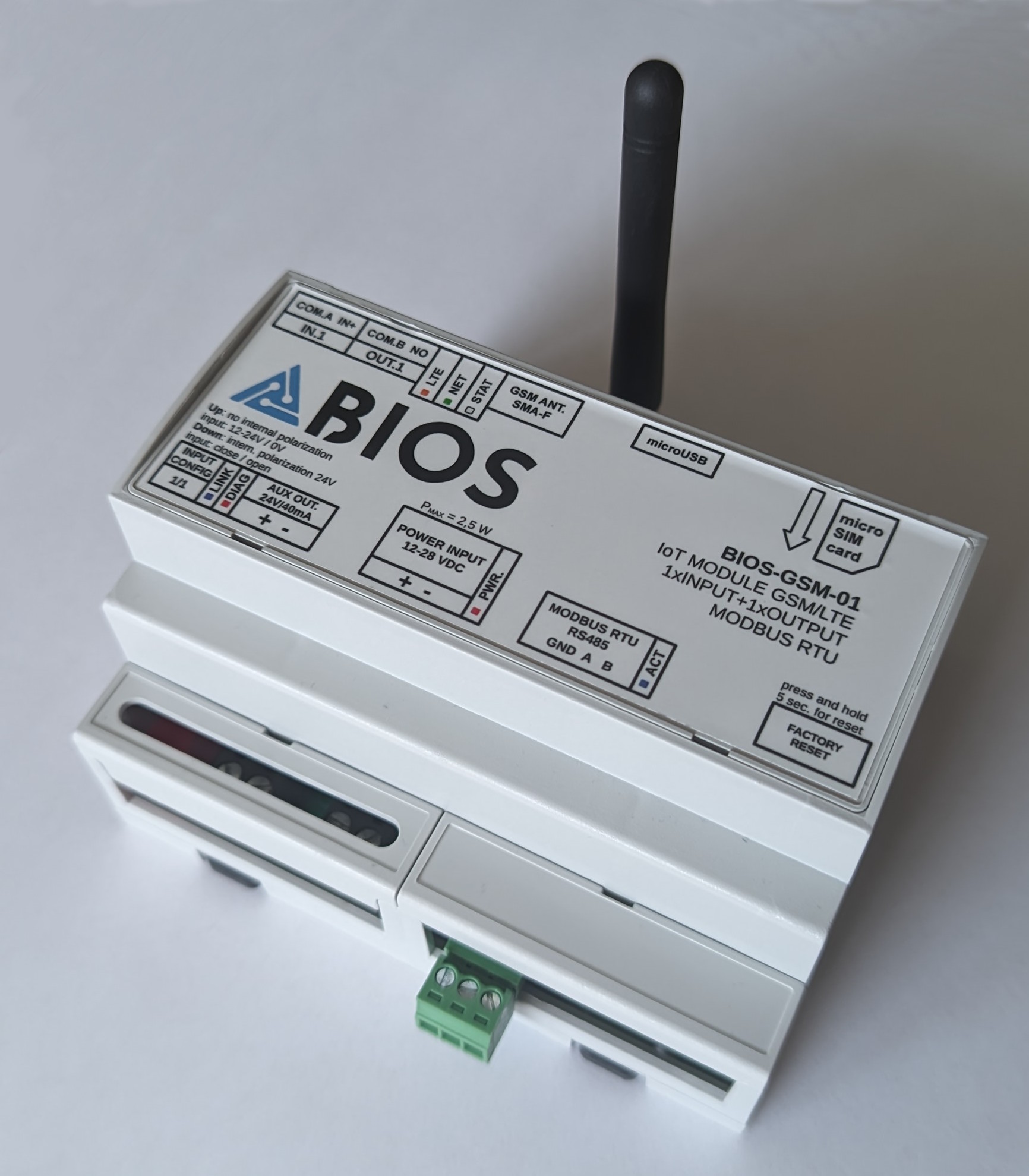
IoT gateway · GSM / 4G LTE · Modbus RTU · DIN rail
BIOS-GSM-01 – Modbus GSM / 4G LTE gateway: Modbus RTU data over MQTT to Microsoft Azure IoT Hub
Collect data from Modbus RTU devices where there is no LAN and send it over the mobile network to the Microsoft Azure cloud.
- Modbus RTU master (RS485): full Modbus RTU support – read and write, configurable transmission parameters
- LTE Cat4 / 3G / 2G modem: microSIM card, private APN support, SMA connector, antenna included
- MQTT (SSL) to Microsoft Azure IoT Hub: native cloud integration
- 1 isolated digital input + 1 NO relay output 2 A, 35 mm DIN rail
What is the BIOS-GSM-01 Modbus GSM / 4G LTE gateway?
BIOS-GSM-01 is a DIN-rail Modbus GSM / 4G LTE gateway: a universal IoT module with a GSM/LTE modem that acts as a gateway between a Modbus RTU bus and the mobile network and sends data, as a Modbus RTU → MQTT gateway, to Microsoft Azure IoT Hub. The module works as a Modbus RTU master on an RS485 bus and supports full Modbus RTU – reading and writing registers of slave devices such as meters, inverters and controllers. RS485 transmission parameters are configurable, with standard baud rates (e.g. 9600, 38400, 115200 bit/s). It mounts on a 35 mm DIN rail.
The module sends data from the devices over LTE Cat4, UMTS/HSPA or GSM/GPRS/EDGE mobile networks using MQTT with SSL encryption to Microsoft Azure IoT Hub. It supports a microSIM card and private APN, and the antenna (included) connects to the SMA connector. This means data from machines and installations reaches the cloud even where there is no LAN.
The module also has a basic I/O set: 1 isolated digital input (0–24 V voltage or dry contact with 24 VDC biasing, selected with a DIP switch, pulses up to 3 kHz) and 1 isolated NO relay output rated up to 2 A, working statically (ON/OFF) or in pulse mode.
The module is configured locally via the microUSB connector (e.g. SIM card and APN) and remotely via the cloud (functional settings, e.g. Modbus addresses to read). It is powered from the POWER INPUT terminals (SELV 12–28 VDC); power consumption is max. 2.5 W. It has built-in thermal and overload protection.
The Microsoft Azure IoT Hub service can be provided by us, or it can be the customer’s or a partner’s cloud – we agree this during deployment. We provide full support with commissioning and configuring the gateway.
BIOS-GSM-01 technical specifications
| Parameter | Value |
|---|---|
| Role | Modbus RTU ↔ GSM/LTE gateway, Modbus RTU master |
| Field interface | Modbus RTU (read and write), RS485 (GND, A, B terminals) |
| RS485 parameters | configurable, standard baud rates (e.g. 9600, 38400, 115200 bit/s) |
| Modem | LTE Cat4, UMTS/HSPA, GSM/GPRS/EDGE (4G/3G/2G) |
| Bands | LTE-FDD: B1/3/5/7/8/20/28; LTE-TDD: B38/40/41; WCDMA: B1/5/8; GSM: B3/8 |
| Cloud transmission | MQTT (SSL) to Microsoft Azure IoT Hub, private APN |
| Supported protocols | Modbus RTU, TCP, UDP, PPP, NTP, NITZ, FTP, HTTP, PING, CMUX, HTTPS, FTPS, SSL, MQTT, MMS, SMTP, SMTPS |
| SIM card | microSIM |
| External antenna connector | 1 × SMA female, antenna included |
| Digital input | 1, isolated: 0–24 V voltage or dry contact with 24 VDC biasing, selected with a DIP switch, pulses max. 3 kHz |
| Relay output | 1, isolated, NO, max. 2 A, life 5×10⁶ cycles, static ON/OFF or pulse |
| AUX OUT auxiliary output | 24 V / 40 mA |
| Configuration | YES, locally via microUSB and remotely via the cloud |
| Power supply | POWER INPUT terminals: SELV 12–28 VDC |
| Power consumption | max. 2.5 W |
| Built-in protection | thermal, overload |
| Terminals | screw terminals 0.35–2.5 mm² (AWG 24–14), max. 0.8 Nm |
| Mounting | 35 mm DIN rail, any orientation |
| Enclosure | ABS UL94V-0, light grey, 6×DIN |
| Dimensions | 107 × 90 × 65 mm |
| IP rating | IP20 |
| Protection class | III / SELV |
| Operating temperature | −35…+60 °C |
| Storage temperature | −40…+85 °C |
| Humidity | RH < 90 %, non-condensing |
| Weight | 160 g |
BIOS-GSM-01 photos
Applications
- Telemetry without a LAN: collecting data from Modbus RTU devices (meters, inverters, controllers) at locations without network infrastructure; the gateway supports Modbus RTU read and write.
- Data in the Microsoft Azure cloud: sending device data via MQTT (SSL) to Azure IoT Hub, with a private APN.
- Simple signals and local control: a digital input for reading a signal or counting pulses and a relay output for control, e.g. of signalling.
- LAN available? See the BIOS-IO-01, BIOS-IO-02 and BIOS-IO-03 modules with HTTP JSON.
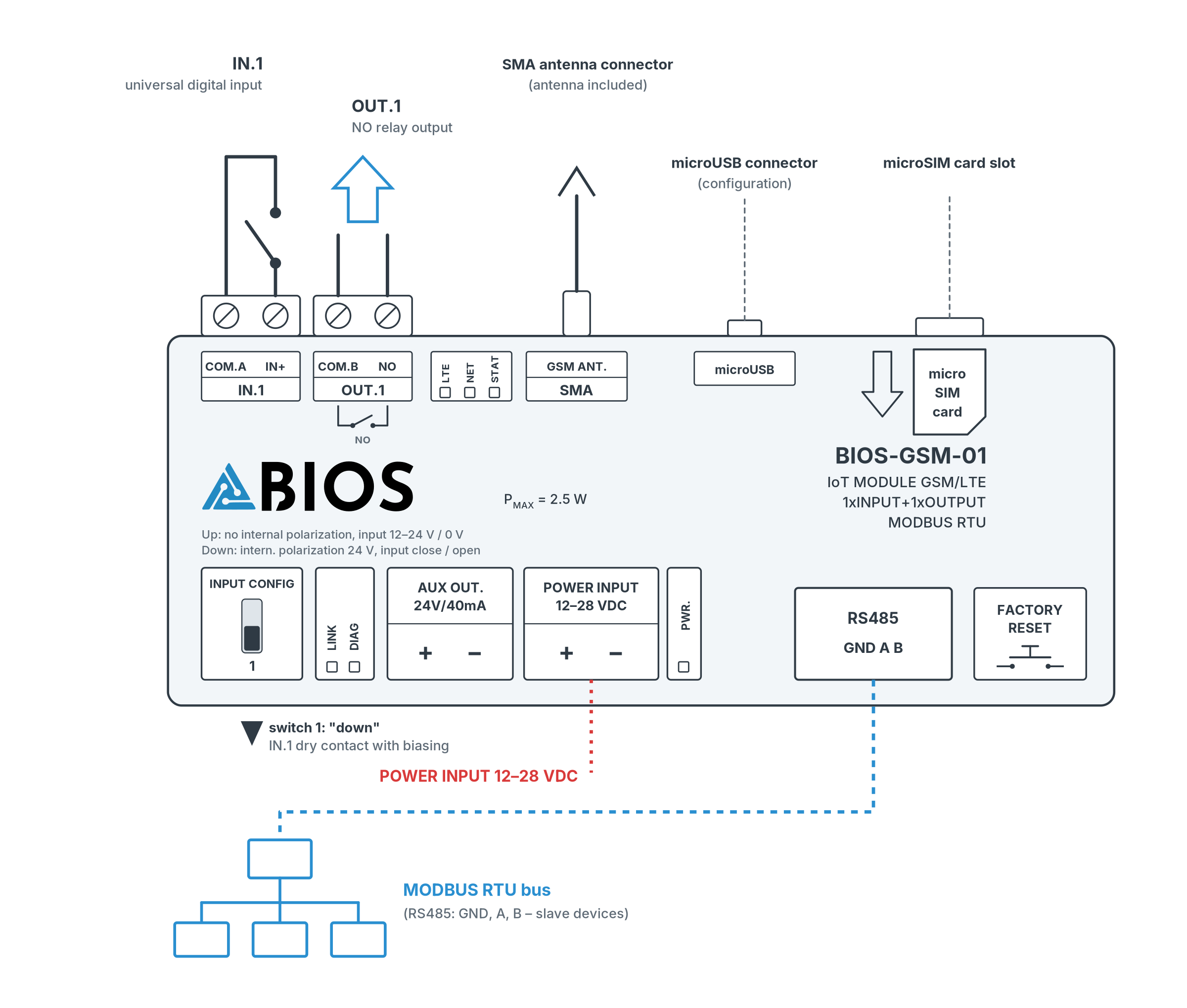
Example wiring
How does the BIOS-GSM-01 Modbus GSM / 4G LTE gateway work?
Data travels from the device to the cloud in a few steps:
- Modbus RTU device: a meter, inverter or controller works as a slave on the RS485 bus.
- RS485 bus: connects the devices to the module’s RS485 terminals (GND, A, B).
- BIOS-GSM-01: as Modbus RTU master, it polls the devices and supports full Modbus RTU – reading and writing registers.
- LTE/3G/2G mobile network: the module sends data over the mobile network.
- MQTT with SSL: data reaches the cloud via MQTT with SSL encryption.
- Microsoft Azure IoT Hub: data goes to the Azure IoT Hub service – provided by us or by the customer or a partner, depending on what is agreed during deployment.
That is how the Modbus GSM/LTE gateway works: the devices and the cloud do not need a LAN at the installation site. We provide full support with commissioning and configuring the gateway.
Downloads
Frequently asked questions about BIOS-GSM-01
BIOS-GSM-01 is a DIN-rail Modbus GSM/LTE gateway that supports Modbus RTU read and write over RS485 and sends device data over LTE/3G/2G mobile networks via MQTT (SSL) to Microsoft Azure IoT Hub.
With Modbus RTU slave devices on an RS485 bus, such as meters, inverters and controllers. The module works as a master and supports Modbus RTU read and write. RS485 parameters are configurable (standard baud rates, e.g. 9600, 38400, 115200 bit/s).
LTE Cat4 (LTE-FDD B1/3/5/7/8/20/28, LTE-TDD B38/40/41), UMTS/HSPA (WCDMA B1/5/8) and GSM/GPRS/EDGE (GSM B3/8). The module uses a microSIM card and supports a private APN.
We provide full support with commissioning and configuring the module. Functional settings, e.g. Modbus addresses to read, can be changed remotely via the cloud. The Microsoft Azure IoT Hub service can be provided by us, or it can be the customer’s or a partner’s cloud – we agree this during deployment.
The digital input (0–24 V voltage or dry contact with 24 VDC biasing, pulses up to 3 kHz) lets you read an additional signal, and the NO relay output (max. 2 A) lets you control e.g. signalling or a simple actuator/output/control device.
From the POWER INPUT terminals with SELV DC voltage of 12–28 VDC. Power consumption is max. 2.5 W.
On a 35 mm DIN rail, in any orientation. The enclosure measures 107 × 90 × 65 mm and takes up 6 DIN modules. The antenna is included and connects to the SMA connector.
At temperatures from −35 to +60 °C and humidity below 90 % RH, non-condensing. The enclosure is rated IP20, so the module is installed in a control cabinet.
It does not need a LAN. The module connects to the cloud over the LTE/3G/2G mobile network with a microSIM card, also via a private APN.
Yes. The module sends data via MQTT with SSL encryption to Microsoft Azure IoT Hub.
The BIOS-IO modules (IO-01, IO-02, IO-03) work on the LAN and provide input and output status over HTTP JSON. BIOS-GSM-01 is a Modbus RTU gateway: it collects data from devices on an RS485 bus and sends it over the mobile network via MQTT to Azure IoT Hub. It has only 1 input and 1 output.
Choose BIOS-GSM-01 when you want to collect data from Modbus RTU devices (e.g. meters, inverters, controllers) at a site without a LAN and send it to Microsoft Azure. Choose a BIOS-IO module when there is a LAN on site and you need to read digital signals or control relays over HTTP JSON.
Yes. The gateway works as a Modbus RTU master and supports full Modbus RTU – reading and writing registers of slave devices on the RS485 bus.
No. The Microsoft Azure IoT Hub service can be provided by us, but it can also be the customer’s or a partner’s Azure cloud – we agree this during deployment. We provide full support with commissioning the gateway.
Request a quote
Want to collect data from Modbus RTU devices where there is no LAN and send it to the Microsoft Azure cloud, or not sure whether to choose the GSM gateway or a BIOS-IO module? Write or call us and we will select the right solution and prepare a quote.
Phone: +48 880 366 728 · E-mail: info@bios-iot.com
Manufacturer: INTSOL sp. z o.o., ul. Radarowa 60, 02-137 Warszawa